
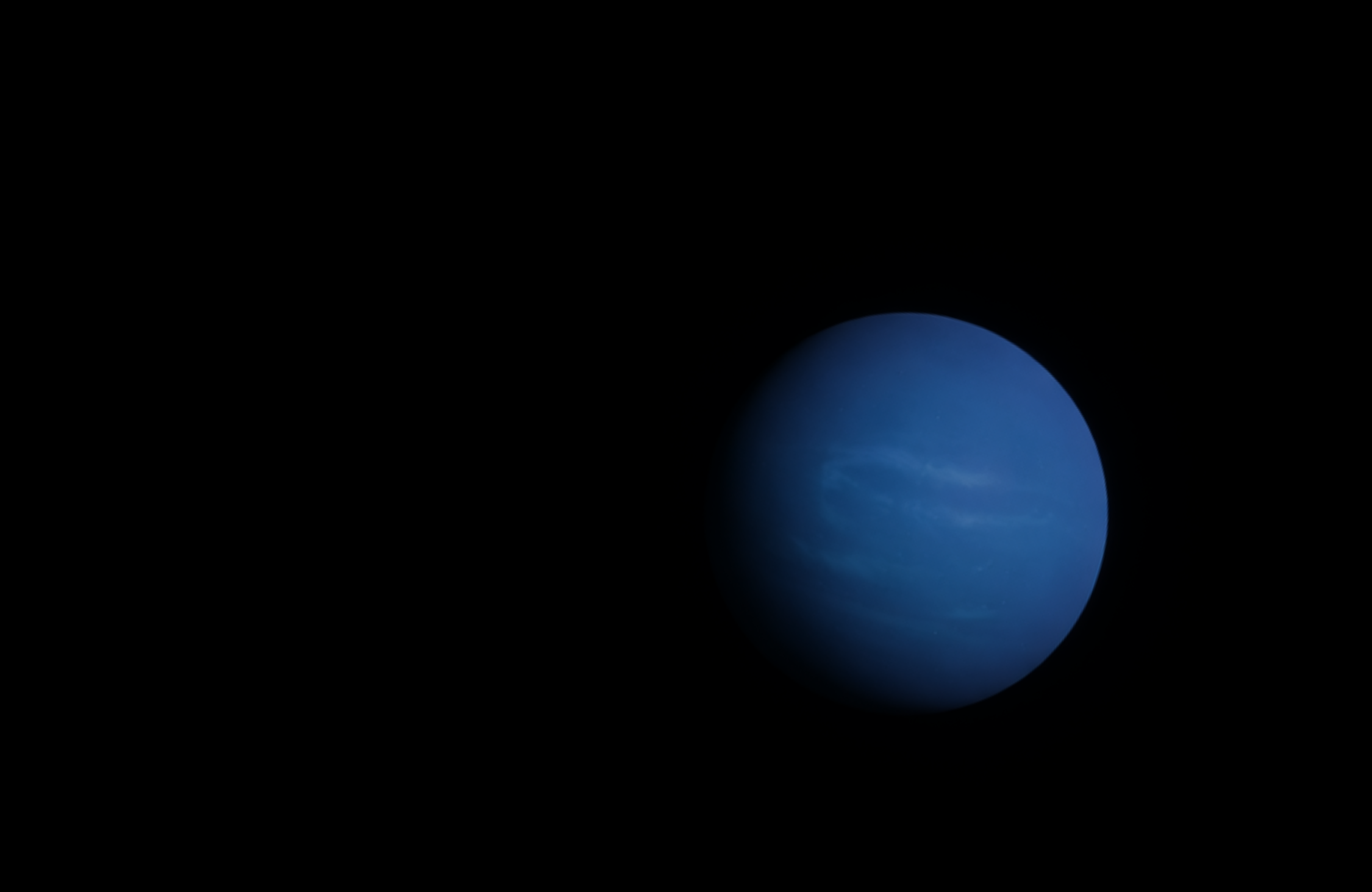
What Neptune really looks like is not what you see in images
Neptune is almost always shown as a bright, glowing blue planet. In images, it looks vivid and colorful, surprisingly luminous for a world nearly five billion kilometers from the Sun.
In reality, Neptune appears much more subdued than these images suggest. It would still appear blue to the human eye, but the color would be deeper, dimmer, and far less intense. Instead of a glowing blue sphere, it would feel colder and more distant, with a softer and more muted tone.
To picture this, imagine looking at the ocean during late evening, just after sunset, when there is still some light in the sky. The water clearly appears blue, but the color is calmer and less vivid, lacking the brightness it has during the day. That softer, more subdued blue is closer to how Neptune would truly appear to the naked eye.
Why Neptune appears dim and less vivid?
The main reason Neptune appears so dim is its extreme distance from the Sun. Orbiting at an average distance of about 30 AU, Neptune is roughly 30 times farther from the Sun than Earth is. Because sunlight spreads out with distance, the planet receives only about 1/900 of the sunlight that reaches Earth. Even though Neptune is large and covered in reflective clouds, there is simply far less sunlight available to illuminate it in the first place.
Neptune’s atmosphere also plays an important role. It contains significant amounts of methane, a gas that absorbs red light efficiently. This absorption gives Neptune its characteristic blue color, but it also reduces the overall amount of light that is reflected back. As a result, the planet appears blue, but in a softer, less vivid tone rather than a bright or glowing one.
In addition to this, human vision struggles in low-light conditions. At such faint levels, our eyes lose much of their ability to perceive color vividly. Even if Neptune were close enough to see clearly, its surface and clouds would not appear saturated or luminous, but more subdued, with only a little variation in tone.
Why Neptune’s true colors aren’t shown in Space images
Images of Neptune are not intended to represent what the human eye would see in real time. Instead, they are designed to reveal scientific detail. At Neptune’s distance, the planet appears extremely dim, and a true-to-eye view would look faint and low in contrast, with most atmospheric features barely visible.
Spacecraft cameras and telescopes collect light differently from human eyes. They use long exposure times, highly sensitive detectors, and filters that isolate specific wavelengths of light. The data is then processed to enhance contrast and color, allowing scientists to study cloud structures, storms, and atmospheric composition. Without this processing, Neptune would appear as a small, faint disk with very limited visible detail, especially when viewed from Earth.
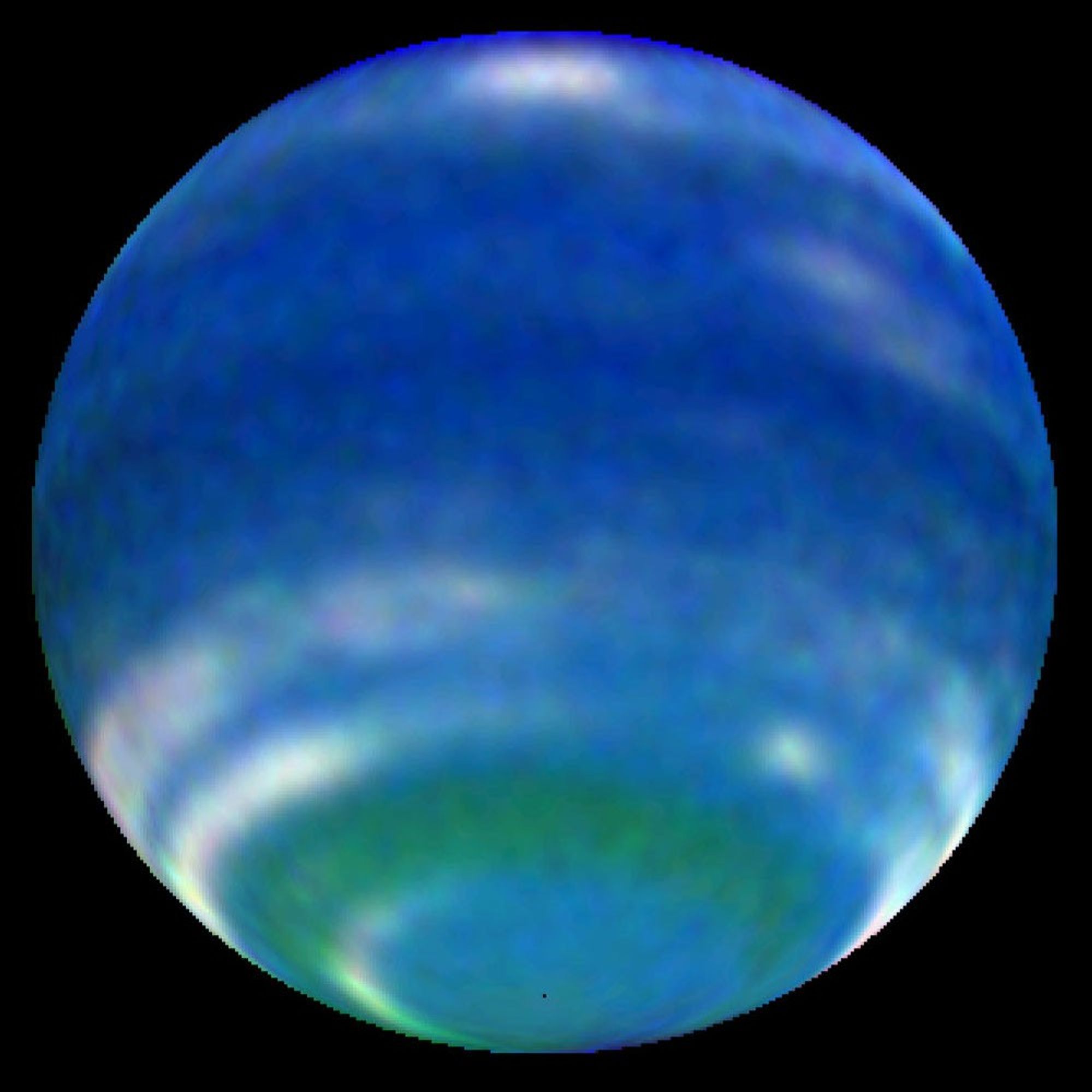
Image credit: NASA, L. Sromovsky, and P. Fry (University of Wisconsin-Madison)
Organisations such as NASA are transparent about this process. The colors shown in published images are scientifically accurate representations of data, but they are not intended to simulate human vision. They translate information into visible form, rather than showing a literal snapshot of what an astronaut’s eyes would see.
In other words, Neptune’s images are brightened and color-enhanced not to mislead, but to make the invisible visible. Showing the planet in its true darkness would hide the very details that make it scientifically valuable.
FAQ
Is Uranus brighter than Neptune?
Yes. Uranus reflects more sunlight overall and appears brighter than Neptune when viewed under similar conditions. Neptune is darker due to its greater distance from the Sun and its atmospheric composition.
How much darker is Neptune than Earth?
Neptune receives only about 1/900th of the sunlight that Earth does. As a result, it is vastly darker, with much lower brightness and contrast than anything seen on Earth under normal daylight conditions.
What planet is the brightest in the solar system?
Venus is the brightest planet as seen from Earth. Its thick, highly reflective cloud cover reflects a large amount of sunlight, making it visible even in daylight under the right conditions.
How cold is Neptune?
Neptune’s average atmospheric temperature is around −214°C (−353°F), making it one of the coldest planets in the solar system.
Are space images edited?
Yes, space images are processed. Brightness, contrast, and color are adjusted to reveal scientific details that would otherwise be invisible. This processing does not make the images fake, but helps translate data into a form humans can study.
Does Neptune have rings?
Yes. Neptune has a faint ring system made mostly of dust and ice particles. The rings are dark and difficult to observe, which is why they were discovered relatively late.
How many km is one AU?
One astronomical unit (AU) is approximately 149.6 million kilometers. It represents the average distance between Earth and the Sun.
Is Neptune visible with a regular telescope?
Neptune can be seen with a small amateur telescope as a tiny, faint blue disk. However, surface details are not visible without large professional observatories or space-based instruments.
Key terms
- Albedo – A measure of how much sunlight an object reflects. High Albedo means a planet reflects a lot of light and when low it’s the opposite.
- Astronomical Unit (AU) – The average distance between Earth and Sun. This unit is used because kilometers become complex.
- Color Saturation – How vivid or intense a color appears.
- Contrast – The difference between light and dark areas.
- Human night vision – The eye’s ability to see color in low light
- Long exposure – Collecting light over time to capture faint objects.
- Nasa – The U.S. agency that explores space and publishes scientific images
- Neptune – Farthest planet in the solar system.
- Reflectivity – A surface’s ability to reflect light.
- Red light absorption – When gases remove red wavelengths from light.
- Ring system – A band of debris orbiting a planet.
- Sunlight intensity – The amount of solar energy reaching an object
- Uranus – 7th Planet from the Sun
Last updated: 2026-04-27