
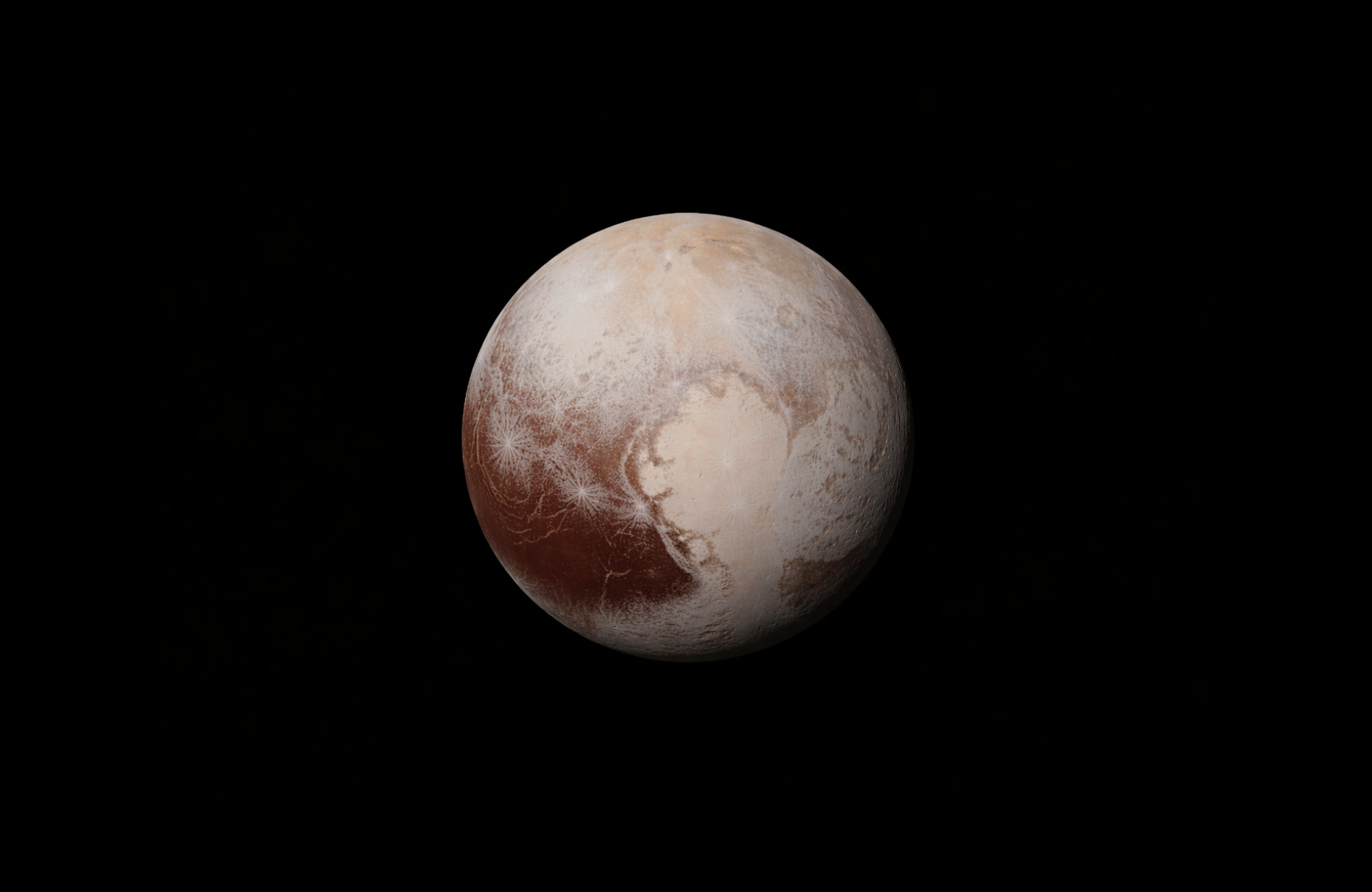
Illustration of Pluto
Why is Pluto no longer considered a planet anymore?
Pluto didn’t change, but our definition of a planet did. For most of the 20th century, Pluto was taught as the ninth planet, until 2006 when astronomers refined the rules of planethood. Pluto no longer meet all of them, and as a result it was reclassified as a dwarf planet, sharing the same category as Eris, Haumea and Makemake.
This decision surprised and even upset many people. After all, Pluto had been considered a planet for generations. So, why is Pluto no longer considered a planet anymore? The answer lies in Pluto’s history and the specific criteria scientists now use.
Pluto's long history as a "planet"
Pluto was discovered back in 1930, at a time when astronomers were still mapping the solar system. Because it orbited the Sun and appeared round, it was labeled as a planet immediately. Textbooks, posters, and classrooms around the world taught generations of students that Pluto was the smallest and most distant planet in the solar system.
Over time, however, astronomers learned more. Pluto turned out to be much smaller than originally thought, surprisingly even smaller than Earth’s Moon. As telescopes improved, scientists found many other similar icy objects beyond Neptune, objects that shared the same neighbourhood as Pluto. Even though Pluto was historically considered a planet, science eventually showed otherwise.
Three rules to be classified as a planet
In 2006, astronomers agreed on a clear definition of a planet. According to this definition, an object must meet three conditions:
- It must orbit the Sun.
- It must be round, shaped by its own gravity.
- It must clear its orbital neighbourhood, meaning it has enough gravitational dominance to sweep away or control nearby objects.
Pluto easily meets the first two conditions. It clearly orbits the Sun, and its gravity has formed it into a round shape just like a regular planet. But the problem lies with the third condition.
Why Pluto fails the third condition
Pluto travels through a region in space called the Kuiper Belt, a vast area filled with many icy bodies and debris left over from the solar system’s formation, spread far apart from each other. Pluto shares this region with many objects of similar size.
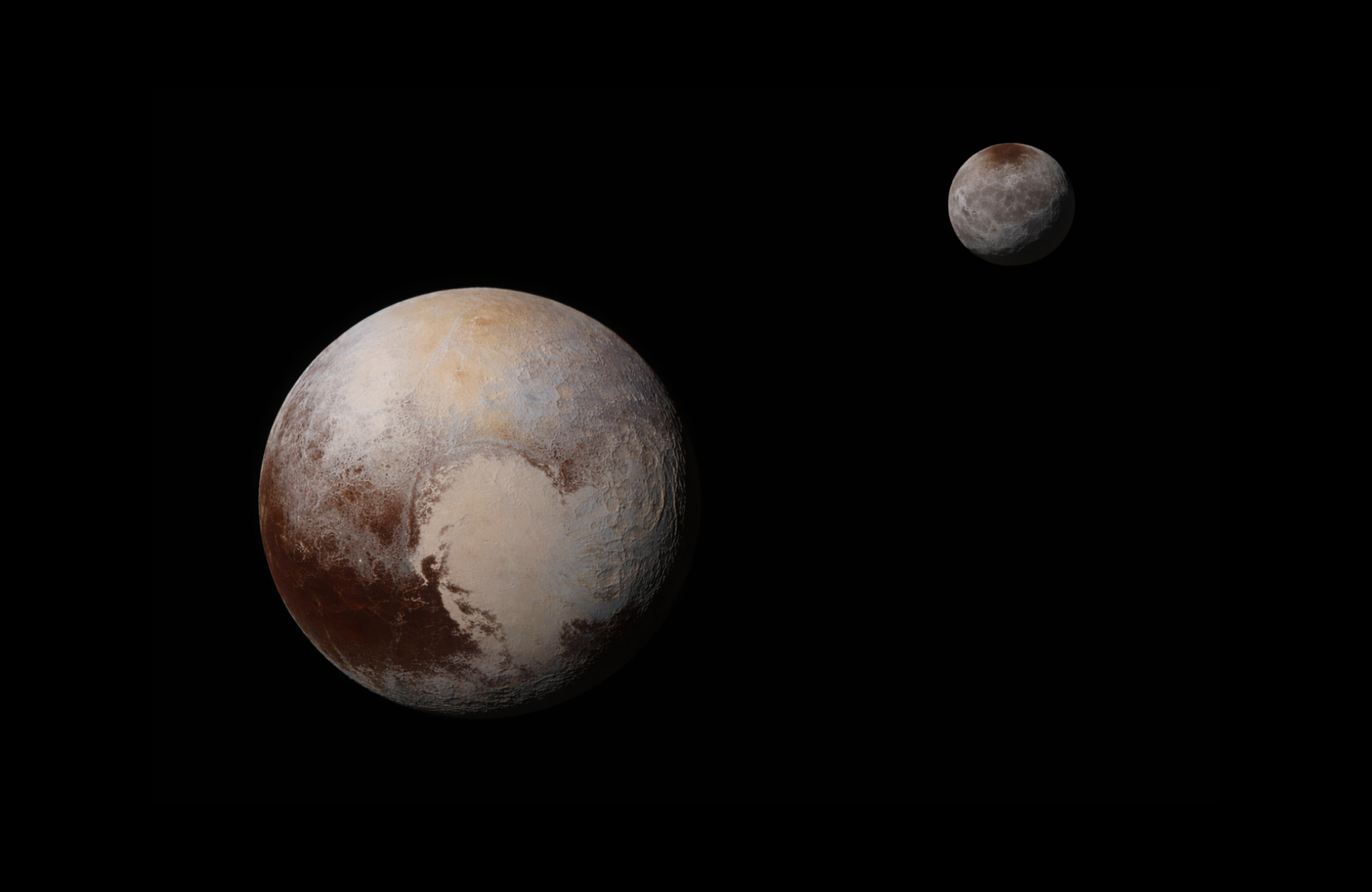
Illustration of Pluto and Charon
Because Pluto is relatively small, with a diameter of about 2400 km and a mass of only about one sixth of our Moon, its gravity is not strong enough to clear its orbit. It does not dominate its path the way planets like Earth and Jupiter do. It also does not fully dominate Charon, its closest moon, which is so massive compared to Pluto, unlike Pluto’s other four moons, that Pluto and Charon orbit a barycenter outside Pluto. In other words, they both orbit a shared point in between them, and the two objects behave more like a binary system. Because Pluto is not gravitationally dominant in its region, it moves among neighbouring objects that it cannot easily control or remove.
What is Pluto now?
Pluto is officially classified as a dwarf planet, but that does not mean it is insignificant. It is still a world in every meaningful sense, with a surprisingly complex surface, frozen plains, tall mountains made of ice, and signs of active geology. It also has a thin atmosphere that grows and shrinks as it moves closer to and farther from the Sun. Unlike other dwarf planets, Pluto is especially well known because of its long history of being taught as “the most distant planet.”
FAQ
Why isn't Mercury classified as a dwarth planet?
Mercury meets all three criteria for being a planet. It orbits the sun, is round due to its own gravity, and has cleared its orbital neighbourhood. Unlike dwarf planets, Mercury is gravitationally dominant in its region of space.
Is the Moon bigger than Pluto?
Yes. Earth’s Moon is larger than Pluto. The Moon has a diameter of about 3474 km, while Pluto’s diameter is only about 2377 km. That means Earths Moon is almost 1100 km wider than Pluto.
What is Pluto's diameter?
Pluto’s diameter is approximately 2377 km.
What year was Pluto discovered?
Pluto was discovered in 1930 by astronomer Clyde Tombaugh.
What is the distance between Pluto and Charon?
The average distance between Pluto and Charon is about 19,600 km. It’s tiny in comparison to the average distance between Earth and it’s Moon which is at 384,400 km.
Is Neptune always closer to Pluto than Earth?
Surprisingly no. Pluto has a highly elliptical orbit, and during a part of it’s orbit it’s actually closer to earth than Neptune. This last happened between 1979 and 1999.
How many moons does Pluto have?
Pluto has five moons: Charon, Styx, Nix, Kerberos, and hydra.
Does Planet X exist?
There is no confirmed evidence that Planet X exists. Some scientists hypothesize a possible distant planet, often called Planet Nine, to explain unusual orbits of far-out objects, but it has not been directly observed.
Key terms
- Barycenter – The shared center of mass that two objects orbit around
- Binary system – Two objects that orbit a shared point, behaving like a pair rather than a single body with a typical moon
- Charon – Pluto’s largest and closest moon
- Dwarf Planet – A spherical object that orbits the Sun but has not cleared it’s orbital neighbourhood.
- Eris – A dwarf planet located in kuiper belt.
- Haumea – A fast spinning, elongated dwarf planet located in Kuiper belt.
- Kuiper Belt – A distant region of our solar system beyond Neptune.
- Makemake – A dwarf planet located in the kuiper belt
- Pluto – A dwarf planet located in kuiper belt, once taught as the ninth planet
- Solar System – A star and everything that orbits around it.
Further exploration
Explore more detailed facts about Pluto from NASA’s official page:
https://science.nasa.gov/dwarf-planets/pluto/facts/
Last updated: 2026-04-12